Ticks and Mosquitoes

Mosquito Information

Mosquitoes generally remain active throughout late summer and into fall. Cases of mosquito-borne illnesses such at West Nile Virus (WNV) and Eastern Equine Encephalitis (EEE) have been reported in the Commonwealth, but NOT in Wellesley. However, Health officials urge all individuals to take precautions to prevent mosquito bites, especially when outdoors in the early morning and at dusk.  Wellesley is part of the East Middlesex Mosquito Control Commission which conducts testing for mosquito-borne illnesses   throughout peak periods during the year.  

Currently, Wellesley's risk for WNV is in the "MODERATE"  category. What does this mean? A mosquito sample has tested positive for WNV.  At this level, infection with WNV is unlikely.  

Wellesley's risk for EEE is in the "REMOTE" category. There have been no positive  samples. 

Helpful Links

Protect Yourself from Mosquitoes

  • Use insect repellent. Use Environmental Protection Agency (EPA)-registered insect repellents with one of the active ingredients below. When used as directed, EPA-registered insect repellents are proven safe and effective, even for pregnant and breastfeeding women.
    • DEET
    • Picaridin (known as KBR 3023 and Icaridin outside the US)
    • IR3535
    • Oil of lemon eucalyptus (OLE)
    • Para-methane-diol (PMD)
    • 2-undecanone
  • Stay inside between dusk and dawn, when mosquitoes are most active. If you can't stay inside, wear long sleeves and pants from dusk to dawn. 
  • Use screens on windows and doors. Repair holes in screens to keep mosquitoes outdoors.
  • Use air conditioning, if available.
  • Stop mosquitoes from laying eggs in or near water. Twice a week, empty and scrub, turn over, cover, or throw out items that hold water, such as tires, buckets, planters, toys, pools, birdbaths, flowerpots, or trash containers.
  • Check for water-holding containers both indoors and outdoors as these attract mosquitoes. 
Updated website line

Tick Information

ticks

One of the most common tick-borne diseases in the U.S. is Lyme disease. Ticks are found in wooded areas, high grass, or leaf litter. They are most active during the spring, summer and fall, but in warmer areas may be active all year round. Residents should take precautions when outdoors, especially during yard work and leaf clean-up. 

Protect Yourself from Ticks

Wear a hat and light-colored clothing (so ticks can be easily spotted), including long-sleeved shirts and long pants tucked into boots or socks.

  • Use insect repellents. Use repellents containing 20–50% DEET on exposed skin and clothing. Reapply repellents as needed. (Always follow products labels).
  • Use insecticides such as permethrin for greater protection. Permethrin can be used on clothing, but not on skin. One application to pants, socks, and shoes may be effective through several washings.
  • Check skin and clothing for ticks daily. Check hair, underarms, behind the ears and groin. Don’t forget to check pets that have been outdoors!
  • Wash and dry clothes using the “hot” settings to kill any ticks present.
  • NOTE: Tick activity continues into Fall and early Winter. Yard work and leaf clean-up are common activities for tick exposure. Residents should take the same precautions listed above. 

Tick FAQs

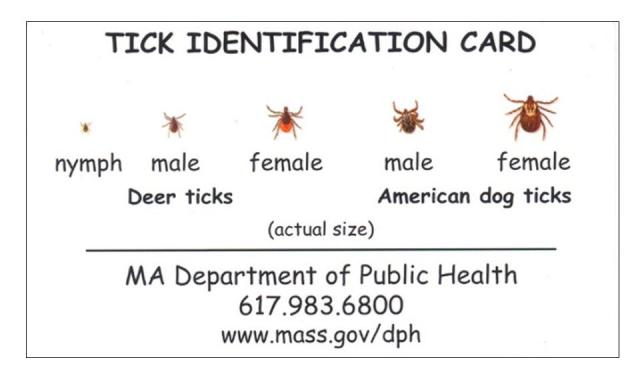
What kinds of ticks carry Lyme and other diseases? What do they look like

What should you do if you find a tick on your body? How do you properly remove a tick? 

What should you do if you suspect you were bitten by a tick or you suspect you have Lyme or another tick-borne disease? 


More Information 

CDC Website

Massachusetts Dept. of Public Health Website

Tick Identification and Testing Services-Fee-based testing labs in and around MA.

Print out and save this tick identification card to take it with you when you go outdoors. https://www.mass.gov/files/documents/2018/01/02/Tick%20Identification%20Card.jpg